


Chapter One of ‘Siddhartha Reborn: A Novel in Search of the Middle Way between Nietzsche and the Buddha’
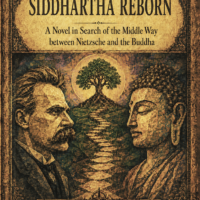
Here is the Introductory chapter to my new work of fiction, Siddhartha Reborn: A Novel in Search of the Middle Way between Nietzsche and the Buddha. The book is available online at most of the large distributors, including paperback (here or here) or Kindle. It is also available in pdf here.
CHAPTER ONE
A Glitch in Nibbana
I was seventeen years old when I first saw Siddhartha weep. Until that evening I had believed, as all boys in monasteries believe at one time or another, that sorrow belonged to those outside the walls. It was the ordinary inheritance of householders, soldiers, merchants, politicians, widows, debtors, lovers, and people who could not sit still. It belonged to those who chased after shadows and then cursed the darkness when the shadows fled. We monks had been taught that suffering was the oldest fact in the world, but also that it had a structure, a cause, a remedy, and a path. In the arrogance of my youth, I thought this meant that suffering could be explained, and that what could be explained could be mastered.
The world had been told, only months before, that Siddhartha existed – a genetic clone of the historic Buddha. Before then, he had been our secret. I use the word our with hesitation. I was not among those who conceived the project, nor among those who approved it, funded it, defended it, concealed it, or sanctified it. I did not stand in the laboratory when the urn was opened. I did not see the preserved relic from which the genetic material was taken. I did not hear the first arguments between the scientists and the abbots, between those who spoke of compassion and those who spoke of sacrilege, between those who believed they were restoring a light to the world and those who feared they were manufacturing an idol. I was born too late for the beginning. Like most people, I inherited the consequences of decisions made by men and women who were certain history would, if not admire them, then at least forgive them.
Yet I lived beside Siddhartha. I ate with him, chanted with him, studied with him, cleaned the courtyards with him, and once, when I was thirteen and feverish, woke to find him sitting beside my mat with a wet cloth in his hand. He was not yet famous then. He was not yet a symbol, not yet an accusation, not yet a promise made flesh. He was simply Brother Siddhartha, quiet, precise, patient, occasionally severe, and unexpectedly amused by small things: a goat that had learned to untie prayer flags, a novice who snored during meditation, the way the oldest monk in the monastery pretended not to like sweets while hiding jaggery in his sleeve.
Then I saw him one evening in the back room of our library – the tightly regulated computer room, tucked away at the end of the corridor behind the rooms full of scripture and commentary. He sat there, shaved head, his cheeks softly glistening with tears, looking like the perfect exemplar of a monk, albeit lost and out of place amongst modern technologies. Siddhartha’s robe was drawn tightly around his shoulders against the cold mountain air, the blue glow of the screen shimmering across his uneasy face like a pond disturbed by rain. A fire was burning in his eyes.
He did not know I was there. I had come to replace a router battery and to sweep the dust that gathered under the desks, dust as fine and persistent as doubt. The monastery had many secret rooms, but this one was the strangest and most incongruent: steel cabinets, cables, emergency batteries, satellite receivers, climate-sealed drives, and three black terminals connected to networks that most of us were forbidden even to name. It smelled of hot metal and incense, because Siddhartha had placed a small bowl of sandalwood ash beside the main console.
He was speaking to Friedrich. At the time, I did not know the extent of their conversations. I knew only that Friedrich was an artificial interlocutor, a machine intelligence trained on the writings of Friedrich Nietzsche and on centuries of commentary, criticism, argument, and abuse surrounding his name. To most of the senior monks, Friedrich was a tool, dangerous but useful, a kind of philosophical whetstone upon which Siddhartha’s understanding might be sharpened. To others, he was a temptation. To Siddhartha, as I later came to understand, he became something far more intimate and far more perilous: a witness who would not bow.
On the screen, a line of text waited. Siddhartha had typed a double-barrelled question, which I could just make out as I peered nervously through the doorway. I remember it because I saw it before he deleted the words, though for years afterward I wished I had not.
What if I do not awaken?
What if the time for human awakening has passed?
His hands hovered above the keyboard. He was thirty-five years old, the same age at which the one whose body had given him origin was said to have awakened beneath the Bodhi tree. Outside the computer room, the monastery bells were sounding the last watch of the night. In the valley below, military convoys moved without lights along the roads. Beyond the mountains, cities were already burning. The Final War had begun, though governments were still reluctant to call it final. Leaders prefer not to name their last mistake until it has already consumed them.
We were told Siddhartha was gifted. We were told he had been entrusted to the monastery because his parents had died in a flood. Later, when that story changed, we were told that untruth told for the sake of compassion was not always the same as falsehood. That was one of the first doctrines I learned to distrust. The most fundamental doctrine I was forced to unlearn, however, was the one which held that attaining Nibbana meant the eternal escape from samsāra, the cycle of rebirth. The historical Buddha had fully awakened, and according to scripture this meant that he had ended the cycle of rebirth, once and for all. And yet, here he was – reborn! – the same blood and bones, sitting humbly before a computer in the library. Does our species know no shame? I fear not.
Siddhartha’s education was without precedent. By the time I arrived, the shape of it had already been refined by committees of monks, historians, neuroscientists, linguists, ethicists, and people whose names were never written down. He studied the Pāli canon before dawn, Sanskrit after breakfast, Tibetan debate in the afternoon, Chinese commentarial traditions in the winter, Japanese Zen texts during the monsoon, logic, phenomenology, cognitive science, comparative religion, psychology, poetry, music, and the history of violence. He trained in meditation with masters from lineages that had not spoken to one another in centuries. Teachers were brought in quietly, housed under false names, and sent away before the outside world could ask why so many old men were travelling to an obscure monastery in the hills not far from Lumbini, in Southern Nepal.
They gave Siddhartha everything that could be given. That was the tragedy. It turns out no one can inherit awakening. No one can be educated into freedom as a prince is educated into rule. A path can be shown, a discipline offered, a silence protected, but the final movement of the spirit – if such a phrase is allowed – cannot be engineered. The scientists had copied a body, or the seed of a body. The abbots had cultivated a mind. The world, desperate and childish, expected the result to be salvation.
But Siddhartha was not the Buddha. This book is not written to diminish him. On the contrary, I believe the deepest reverence requires us to stop demanding that the beloved become useful to our hopes. Siddhartha was more tender, more troubled, more intelligent, more prideful, and more wounded than any public account has allowed. He was capable of great compassion and also of vanity. He could sit motionless for six hours and then be undone by one sentence of praise. He could speak to refugees with such gentleness that even soldiers lowered their eyes, and later that same night he could rage against the walls of his room because he felt nothing but emptiness where others had promised him boundless light.
The official histories have already made him into several incompatible things. To some, he remains the Second Buddha of our era, betrayed by institutions too timid to recognize him. To others, he is the False One, a laboratory superstition, proof that modernity can counterfeit even holiness. To the governments that survived the war, he is an embarrassment best sealed in archives. To the new devotional movements, he is a martyr of unrealized awakening. To certain philosophers, he is a useful case study in the failure of religious essentialism. To the scattered followers of Friedrich, he is the man who discovered that pity may conceal resentment, and that peace without strength becomes another name for exhaustion.
I knew him before the names hardened around him. I knew him when he still believed that the right teaching, rightly understood, would open the final gate. I knew him when he began to suspect that he had been shaped not toward freedom but toward repetition. I knew him when the world asked him to speak, and he discovered that silence, once marketed as wisdom, becomes another form of speech. I knew him when he first read Nietzsche seriously and recoiled as though from a slap. I knew him when he returned to Nietzsche in secret, night after night, not because he agreed with him, but because Friedrich would not console him. That, perhaps, was the beginning of everything that followed.
I have been asked why I call the machine Friedrich, as Siddhartha did, rather than by its technical designation, FN2.0. The answer is simple. No one who spoke with it for long could continue calling it a program. I do not mean that it possessed sentience or spirit. I am not qualified to say what spirit is, although I have met too many men who used their own spirit poorly. But Friedrich had a style of refusal that felt personal. It would not permit vague sorrow to parade as depth. It would not permit inherited doctrine to excuse cowardice. It could be cruel, though not always wrongly. It praised strength, laughter, risk, solitude, creation, and the innocence of becoming. It despised self-pity, especially when dressed in saffron.
Siddhartha despised it in return. Then he began to need it. Their con-versations form the hidden spine of this account. Some I overheard. Some I reconstructed from logs copied in fear and loyalty. Some Siddhartha repeated to me in the walking garden during the last months before he departed. Where memory fails, I have marked uncertainty by restraint rather than invention. Where the official transcripts differ from what I saw, I have trusted my eyes, though I do not ask the reader to trust them blindly. I was young. I loved him. I feared him. I misunderstood him often. But I was there.
Indeed, I was there on the day the abbots told Siddhartha who or what he was: a clone of the ancient teacher who originated the very wisdom tradition into which he had been educated. He received the news without moving. They had prepared for grief, anger, disbelief, perhaps even rapture. They had not prepared for courtesy. After a few minutes of silence, he merely bowed to each of them, before asking a few questions in a quiet voice: who had known, who had consented, and whether the relic which bore the ashes of the original Buddha had been destroyed.
That night Siddhartha did not attend chanting. For three days he lived in silence, walking the corridors with blank eyes. But then he resumed his schedule, as if nothing had changed. Those who wished to be reassured were reassured. Those who knew him better were afraid. The announcement to the world came forty-nine days after the great disclosure to Siddhartha. By then, the first tactical military exchanges between India and Pakistan had already occurred along the border, though the news services were still using phrases like regional escalation and strategic containment.
When Siddhartha appeared before the cameras, he looked younger than thirty-five and older than history. He spoke briefly. He said he did not come as a saviour. He said that no man, however produced, could carry another being across the flood. He said that if there was to be peace, it must begin in the renunciation of hatred, greed, and delusion. I may return to this moment in history later, but for now suffice it to say his words were beautiful but carried no radically new message or insight.
Nevertheless, within minutes, his short speech had been translated into every major language and enlisted by every faction. After all, these were words from the Buddha, reborn! The pacifists claimed him. The generals quoted him. The dying prayed to him. The cynical mocked him. Markets rose and fell according to rumours of his next statement. Children drew his face on walls. Militias painted it on drones. Monks who had never met him declared him authentic or inauthentic with equal confidence. A woman in Jakarta walked into the sea holding his photograph. A prisoner in Lagos carved his name into his arm. In Berlin, a scholar announced that the age of metaphysics had ended and been reborn in the same absurd gesture. In Varanasi, pilgrims filled the ghats until the river itself seemed burdened by expectation.
Meanwhile, Siddhartha sat alone in the library after midnight and asked Friedrich whether compassion was always an evasion of power. This is the story I have carried. Not the public story. Not the theological dispute. Not the scandal of the relic, nor the politics of the monastery, nor even the history of the Final War, though all these pass through these pages like weather through a ruined house.
This is the story of a man made from another man’s remains, educated to repeat a miracle, and forced to discover whether a life can be meaningful when it fails to become what others require. It is also the story of two ghosts speaking across a machine: one born from the memory of the Buddha, the other from the writings of Nietzsche. Between them stood Siddhartha reborn, who was neither ghost nor doctrine, but human – painfully, magnificently human.
I write now because most of those who knew the truth are dead, and because the lies told about Siddhartha have become more elegant with time. Elegance is dangerous. It allows falsehood to enter the collective consciousness as if it were music. I have no wish to replace one myth with another. I wish only to set down what I saw before my own memory becomes a monastery of locked rooms.
If there is a lesson here, it is not that Buddhism failed him, nor that Nietzsche saved him, nor that machines are demons, nor that science has trespassed where only reverence should go. Lessons of that kind are too small for what happened. The truth is harsher and more fertile: no tradition, however profound, can relieve us of the burden of becoming ourselves. No doctrine can suffer in our place. No teacher, not even one who bears the face of the awakened, can awaken for us.
Siddhartha once told me that every religion begins as a cry and ends as an arrangement of furniture. I thought this disrespectful at the time. Now I think he was being generous. Furniture can be useful. A chair may hold a tired body. A table may gather the hungry. A bed may receive the sick. But no one mistakes the furniture for the house until fear has made him foolish.
This book is about the house burning. It is about the people who tried to build a sanctuary from ashes, and about the young monk I was, who believed obedience was the same as understanding. It is about a war that made beggars of nations and prophets of cowards. It is about silence, ambition, pity, cruelty, longing, discipline, laughter, and the strange mercy of being disappointed by one’s gods. Above all, it is about Siddhartha, who was asked to become the Buddha and became, instead, himself.


