


The Poet-Farmer (interview question #9)
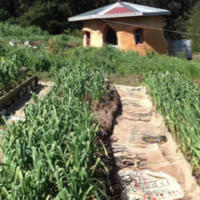
Dr Simon Ussher has started emailing me interview questions about my recent books on aesthetics (see here). Over coming weeks I’ll post my responses to his questions.
You have mentioned this idea of the ‘poet-farmer’. Can you offer more insight into this character or archetype? To what extent is it indebted to Henry David Thoreau?
Yes, the figure of the ‘poet-farmer’ is one of the central archetypes in the ecological civilisation I’m calling SMPLCTY. It is my attempt to symbolise a reconciled mode of human existence – one that overcomes the false division between intellectual and manual labour, between art and economics, between culture and subsistence, between contemplation and production.
The poet-farmer is someone who lives simply in material and energetic terms, while cultivating richness in the aesthetic, spiritual, communal, and creative dimensions of life. This figure participates in the necessary work of provisioning society – growing food, building shelter, maintaining community infrastructures and institutions – but does so in ways that are non-alienated, meaningful, and infused with creativity.
The idea emerges partly as a response to industrial capitalism, which radically fragments and alienates human life. Under modern conditions, many people perform highly specialised labour disconnected from any immediate sense of meaning, beauty, or wholeness. Work becomes instrumental and often ecologically destructive, while art becomes professionalised, commodified, or marginalised as a luxury activity. The poet-farmer represents an effort to heal those fractures.
Of course, I use the term ‘poet’ here in a broad sense. I do not mean only someone who writes verse. I mean someone who approaches existence creatively and aesthetically – someone engaged in what philosopher Michel Foucault called an ‘aesthetics of existence’. Likewise, ‘farmer’ does not necessarily imply someone literally engaged in agriculture, though food cultivation is certainly important. Rather, it signifies grounded participation in the material realities of life and ecological dependence. The poet-farmer therefore unites earth and imagination, necessity and beauty.
As you perceived, this archetype is deeply indebted to the pioneering environmentalist Henry David Thoreau. In many ways, Thoreau stands behind the entire project of SMPLCTY. His experiment at Walden Pond remains one of the most profound critiques of industrial modernity, not because he rejected civilisation outright, but because he asked some devastatingly simple questions:How much is enough? And enough for what?
Thoreau understood that the cost of things is measured not primarily in money but in ‘the amount of life’ required to obtain them. That insight is radical and subversive. He saw that people were sacrificing their lives – their freedom, vitality, and capacity for contemplation – in pursuit of unnecessary luxuries and socially manufactured desires. Against this, he proposed a life that was materially modest but existentially abundant.
I draw very heavily from that vision. I insist that voluntary simplicity is not about grim renunciation but about liberating time and energy for higher forms of flourishing – friendship, art, political participation, philosophy, immersion in nature, craft, and aesthetic experience. Thoreau exemplified this possibility. He cultivated beans, built his own cabin, wandered the woods, kept detailed journals, contemplated the seasons, and transformed ordinary existence into a poetic and philosophical practice.
That is why I devote an essay to what I call ‘A Thoreauvian Aesthetics of Sufficiency’. I argue there that ecological civilisation will require not merely technological change or economic restructuring, but a transformation of taste itself – an aesthetic transformation of what people desire and how people imagine the good life. Thoreau’s genius was to show that simplicity can be beautiful, liberating, and spiritually rich rather than restrictive or debilitating.
However, I also try to move beyond Thoreau in certain respects. Thoreau’s experiment was intensely individualistic. He largely withdrew from society in order to clarify his own relation to life. While I admire that immensely, my own work asks how something analogous could become social, democratic, and civilisational. How might entire communities live as ‘poet-farmers’? How might economies and institutions be reorganised to support widespread forms of meaningful, low-impact, creative living?
That is where thinkers like William Morris, Herbert Marcuse, Ivan Illich, Gandhi, and the degrowth and permaculture movements become important for me alongside Thoreau. I want to democratise the poet, as I put it in the book. The goal is not to preserve art and artful living as the privilege of a talented elite, but to create conditions in which ordinary people can reclaim their capacities for creativity, craft, and aesthetic self-formation.
The poet-farmer is therefore not a nostalgic return to the past. It is not primitivism. Nor is it merely a lifestyle identity. It is an archetype for a post-consumerist civilisation – a symbol of what human beings might become if we consciously choose sufficiency over excess and creative participation over passive consumption. An increased openness to aesthetic value is a way to minimise society’s energy and resource demands without diminishing, and indeed increasing quality of life. After all, one is less likely to seek meaning, happiness, and beauty in consumerism if one has already found those things outside the marketplace – in the freely available aesthetic dimensions of life.
In the end, the poet-farmer represents a different answer to the question of progress. Industrial civilisation defines progress as increasing complexity, consumption, speed, and power. The poet-farmer suggests another possibility: that genuine progress might consist in becoming more fully human, more ecologically integrated, and more aesthetically and spiritually awake.


